Secondary Steel for Structural Fabrication: When Cosmetics Don't Matter
Collier Metals | Secondary Steel Education Series | 9 min read
Yes, secondary steel is suitable for structural use. Secondary steel meets the same ASTM specifications as prime material — same chemistry, same yield strength, same tensile strength, same elongation. The only difference is cosmetic: surface scratches, roll marks, staining, minor coating variations, or off-standard dimensions that the original buyer didn't want. None of those issues affect how steel performs under load.
For structural fabricators, this creates a significant opportunity. The majority of structural applications — equipment bases, mezzanine framing, stair treads, platforms, bracing, base plates — are welded, painted, enclosed, or otherwise hidden from view. Nobody inspects the surface finish of a mezzanine column after it's been primed, painted, and bolted into place. Yet many fabricators are paying prime prices for material going into exactly these applications.
This guide covers the engineering basis for using secondary steel in structural fabrication, which applications are ideal candidates, how to verify code compliance, and what kind of cost savings are realistic.
Why Secondary Steel Performs Identically to Prime in Structural Applications
Structural performance in steel is determined by three mechanical properties, all of which are set during steelmaking and rolling — not by what happens to the surface afterward:
Yield Strength — The stress at which the steel permanently deforms. This is the primary design value for structural engineers. A36 steel requires a minimum of 36 ksi regardless of whether the surface has scratches or staining.
Tensile Strength — The maximum stress before fracture. This provides the safety margin above yield. A36 requires 58–80 ksi tensile whether the coil is prime or secondary.
Elongation — How much the steel stretches before failure, indicating ductility. This matters for seismic design, energy absorption, and preventing brittle fracture. Secondary steel has the same elongation as prime because it's the same material.
These properties are intrinsic to the steel's chemistry and microstructure. A scratch on the surface doesn't change the carbon content. A roll mark doesn't alter the grain structure. An oil stain doesn't reduce the cross-sectional area carrying load. The steel under the surface imperfection is identical to prime steel at every level that affects structural performance.
Building Code Compliance: What You Need to Know
The most common concern fabricators raise about secondary steel is code compliance. Here's the straightforward answer: building codes and structural steel specifications don't distinguish between prime and secondary. They specify material properties.
ASTM Specifications Apply to the Steel, Not Its Cosmetic Grade
When a structural engineer specifies ASTM A36 on a drawing, they're requiring:
Minimum 36 ksi yield strength
58–80 ksi tensile strength
Minimum 20% elongation (in 8″ for plates; verify for your specific thickness)
Defined chemical composition limits (carbon, manganese, phosphorus, sulfur, silicon)
A secondary steel coil that meets all of those requirements is fully compliant with A36 — period. The specification doesn't include a line item for "must not have roll marks" or "surface must be cosmetically perfect." It specifies chemistry and mechanical properties, both of which are verified through testing and documented on the mill test report.
Mill Test Reports Provide Full Traceability
Secondary steel comes with the same mill test reports (MTRs) as prime material. The MTR documents:
Heat number for traceability back to the specific melt
Chemical composition (actual values, not just specification limits)
Mechanical test results from the producing mill
ASTM specification compliance
Producing mill identification
When you buy secondary steel from a reputable source, the MTR follows the material. This gives you the same documentation chain that prime steel provides — the same paperwork your customers, inspectors, and quality systems require.
Supplemental Mechanical Testing Removes Any Doubt
Beyond the original MTR, secondary steel can be independently tested to re-verify mechanical properties. This is standard practice for quality-conscious secondary steel processors. The supplemental test results serve as a second confirmation that the material meets specification — giving you documented proof that goes beyond what most prime steel purchases include.
THE CODE COMPLIANCE BOTTOM LINE Building codes specify material properties — not cosmetic appearance. Secondary steel that meets ASTM A36 chemistry and mechanical requirements is A36, with the same MTR documentation and traceability as prime. Supplemental testing provides an additional layer of verification that most prime steel purchases never receive.
Ideal Structural Fabrication Applications for Secondary Steel
The best candidates for secondary steel share common characteristics: the finished parts are structural rather than decorative, they'll be painted or coated, and surface appearance is either hidden or irrelevant. Here are the applications where secondary steel delivers the biggest impact.
Equipment Bases and Mounting Plates
Equipment bases are one of the highest-volume structural applications for secondary steel. These heavy plates support machinery, HVAC units, generators, and industrial equipment. They're welded, drilled, painted or galvanized, and bolted to a floor. Nobody sees the surface finish after installation, and the only thing that matters is whether the plate can handle the design load. Secondary steel in A36 or A1011 HSLA handles that identically to prime.
Mezzanine Framing and Structural Platforms
Mezzanine structures are fabricated from beams, columns, bracing, and deck plates — all of which get welded together, primed, and painted. The structural members are hidden behind decking, handrails, and finishes. Surface scratches or roll marks on the raw steel are completely irrelevant once the structure is assembled and coated. This is an application where the 15–25% cost savings on secondary material drops directly to the bottom line on projects that consume significant tonnage.
Stair Treads, Platforms, and Grating Supports
Industrial stair treads and platforms are classic structural applications: they carry live loads, get welded to stringers, and receive a non-slip coating or tread pattern. These parts are designed to be functional, not decorative. Cosmetic surface defects like scratches, minor staining, or roll marks are invisible under the finished coating and have zero bearing on the tread's load rating.
Structural Bracing and Gusset Plates
Bracing members and gusset plates connect structural elements and transfer forces between them. They're hidden inside wall cavities, above ceilings, or behind cladding. The design requirement is yield strength and weld quality — not surface cosmetics. These are often cut from heavier gauge material where secondary steel availability is strong and savings are meaningful.
Trailer and Vehicle Frames
Trailer decking, frame components, and cross-members are high-volume structural applications. These parts endure heavy loads, vibration, and weather exposure — but they get primed, painted, or undercoated during manufacturing. The surface condition of the raw steel is irrelevant to the trailer's structural rating, and the cost savings on material accumulate fast when you're building frames in volume.
Base Plates for Columns and Machinery
Column base plates transfer structural loads into foundations. They're typically heavy gauge (7 gauge through 3 gauge or thicker), welded to columns, drilled for anchor bolts, and embedded in grout or concrete. After installation, nobody will ever see the base plate again. Specifying prime steel for a component that's going to be buried in concrete is paying for cosmetics that serve no purpose.
Guards, Enclosures, and Protective Covers
Machine guards, electrical enclosures, protective bollard plates, and equipment covers are structural in function but almost always painted or powder-coated. The coating covers any surface imperfections completely, and the design requirements are about impact resistance and load capacity — properties that secondary steel delivers identically to prime.
Secondary Steel Suitability by Application
This table summarizes which structural fabrication applications are strong candidates for secondary steel and why.
| Application | Typical Gauge | Why Secondary Works | Suitability |
|---|---|---|---|
| Equipment bases & mounting plates | 7 ga – 3 ga | Hidden after install; painted or galvanized | Excellent |
| Mezzanine framing | 10 ga – 3 ga | Welded & painted; hidden behind finishes | Excellent |
| Stair treads & platforms | 11 ga – 7 ga | Non-slip coating covers surface; load capacity is what counts | Excellent |
| Bracing & gusset plates | 10 ga – 3 ga | Concealed inside assemblies; strength is the only spec | Excellent |
| Trailer frames & decking | 7 ga – 3 ga | Primed & painted; high volume = big savings | Excellent |
| Column base plates | 7 ga – 3 ga | Buried in grout/concrete after install | Excellent |
| Guards & enclosures | 11 ga – 7 ga | Powder-coated or painted; function over form | Excellent |
| Architectural exposed steel | Varies | Surface is final visible finish — cosmetics matter | Case-by-Case |
Why Surface Cosmetics Don't Affect Structural Performance
If you've read our guide on surface defects vs. structural defects in steel coils, you know that the vast majority of reasons steel gets classified as "secondary" are purely cosmetic. Here's a quick summary of the defect types that are common in secondary steel and completely irrelevant to structural fabrication:
Cosmetic Defects You'll See on Secondary Steel — and Can Ignore
Scratches and friction gouges — Shallow linear marks from handling and processing. They don't reduce the steel's cross-section or alter its properties. They disappear under primer.
Roll marks, roll bruises, and chatter marks — Surface impressions from mill equipment. These are texture variations, not material defects. They have no effect on yield or tensile strength.
Oil stains, rust spots, and acid staining — Discoloration from processing fluids or light surface oxidation. Standard blast cleaning or chemical prep before painting removes all of these. They don't affect the steel underneath.
Color variation and dull appearance — Common in galvanized secondary steel. The zinc coating is still there, still at spec weight, and still providing corrosion protection. The only difference is visual consistency.
Coil breaks — Narrow deformation lines from coiling tension. These are shape defects, not cracks. They don't reduce structural capacity, though they may show through thin paint on exposed surfaces — which is not a concern for structural fabrication.
Off-width or off-gauge — The original coil didn't meet the buyer's width or gauge specification, but the material itself is perfectly sound. Precision slitting corrects width issues, and as long as the actual thickness meets your design requirements, off-gauge material is fully usable.
Defects That Do Matter — and How They're Screened Out
Not every secondary coil is suitable for structural use. Responsible secondary steel suppliers screen for defects that genuinely affect structural integrity:
Through-thickness cracks (transverse, longitudinal) — These are stress concentrators that can propagate under load. Coils with these defects should be rejected for structural applications.
Lamination — Internal layer separation that reduces effective thickness. Not suitable for structural use.
Holes or severe material loss — Any defect that removes material from the cross-section reduces load capacity.
Severe inclusions — Large non-metallic inclusions can act as crack initiation sites under fatigue loading.
The key point: these defects are identified and excluded during the evaluation process. What reaches the fabricator is material with cosmetic imperfections only — mechanically sound steel that performs identically to prime.
THE PAINT TEST Here's a simple way to evaluate whether secondary steel works for your application: if the part will be painted, primed, powder-coated, galvanized, or otherwise coated before it reaches the end user, then cosmetic surface defects are irrelevant. The coating covers everything. You're paying a premium for appearance that will be hidden under the first coat of primer.
Cost Savings: What Secondary Steel Means for Structural Fabrication Budgets
Structural fabrication is a high-volume, cost-competitive business. Material cost is typically 40–60% of total project cost, which means even modest percentage savings on steel translate into significant dollar improvements on the bottom line.
Secondary steel for structural applications typically runs 15–25% below prime pricing, depending on the specific material, gauge, and market conditions. Here's what that looks like on a real project:
A single mezzanine project using 30 tons of A36 10 gauge — At a 20% discount, that's roughly $5,400 in material savings on one job, with zero compromise in structural performance.
A trailer manufacturer consuming 15 tons per week of 7 gauge — A 15% material cost reduction adds up to over $100,000 in annual savings, assuming typical market pricing.
An equipment fabricator using 5,000 lbs of 3 gauge base plate monthly — Even at smaller volumes, secondary material puts thousands of dollars back into the operation each year.
These savings don't come with trade-offs in performance, testing, or documentation. The steel meets the same spec. It comes with the same MTR. It's verified through the same (or more rigorous) testing. The only thing you're not paying for is cosmetic surface perfection that your application doesn't require.
Additional Advantages Beyond Price
Cost savings are the headline, but secondary steel offers other advantages that matter for structural fabricators:
Faster lead times. Prime mill orders typically run 4–8 weeks for domestic mills. Secondary steel is available in days to weeks because it's already produced and sitting in inventory. For fabricators juggling project schedules and change orders, fast material availability can be more valuable than the cost savings.
Smaller minimums. Mills require 40,000–50,000 lb minimum orders. Secondary steel is available in smaller quantities — as low as 5,000 lbs in specialty gauges. This means you can buy what you need for a specific project without tying up capital in excess inventory.
Processing included. Secondary steel from a service center with in-house slitting and leveling means the material arrives ready to fabricate. Edge defects are trimmed off. Shape issues are corrected. Width is slit to your specification. That eliminates a processing step and the logistics of coordinating with a separate slitter.
How Collier Metals Supplies Secondary Steel for Structural Fabrication
At Collier Metals, structural fabrication is one of the primary applications we serve with our secondary steel program. Here's what that looks like in practice:
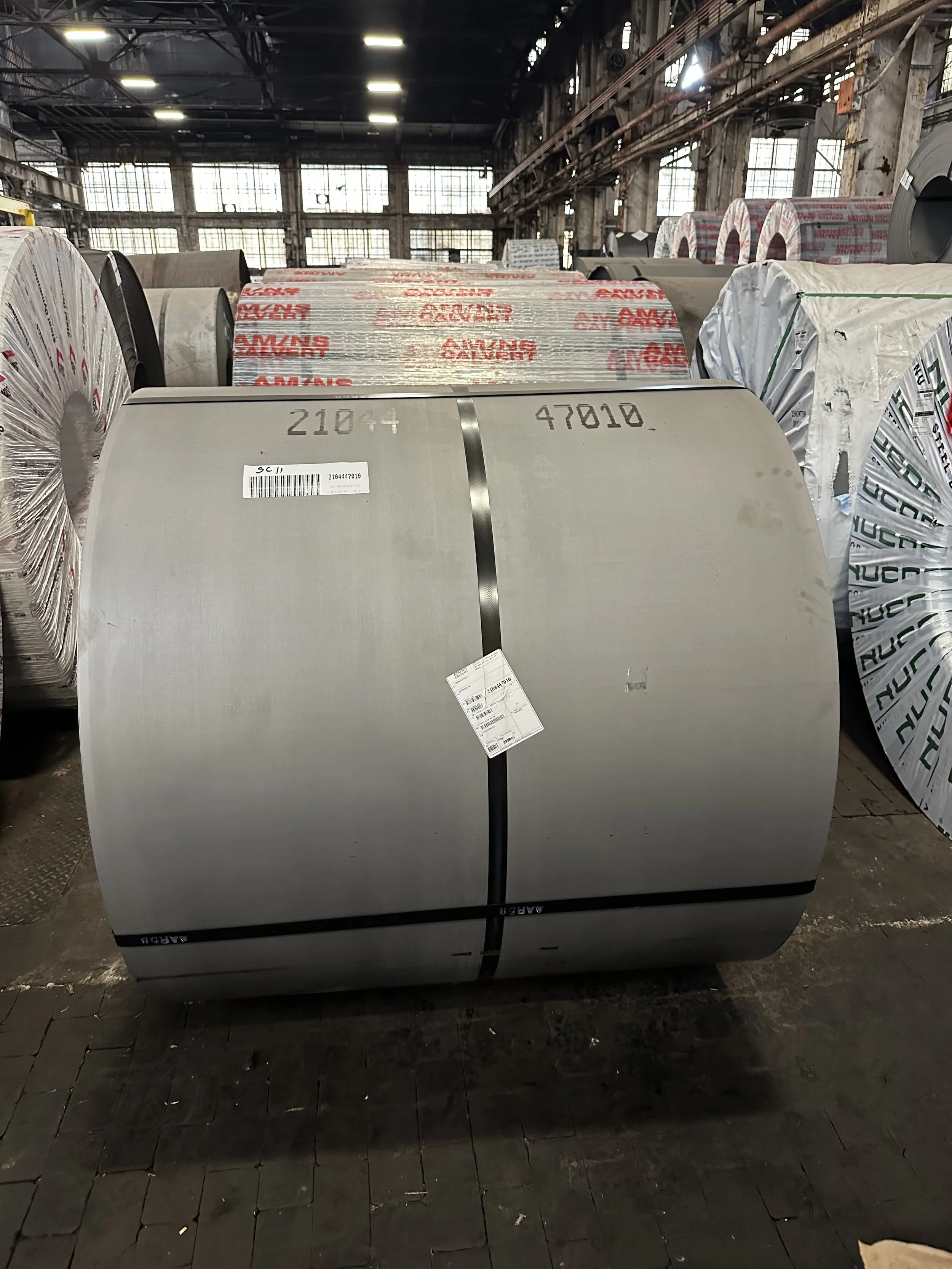
Material sourcing: We source exclusively from domestic mills — Nucor, Cleveland-Cliffs, Steel Dynamics, and other major U.S. producers. All material meets ASTM specifications with full heat traceability.
Defect evaluation: Every coil is evaluated against our 150+ defect reference system. We categorize defects as cosmetic or structural, and material with genuine structural defects is excluded from inventory.
Mechanical testing: We test yield strength, tensile strength, and elongation to verify the material meets specification requirements.
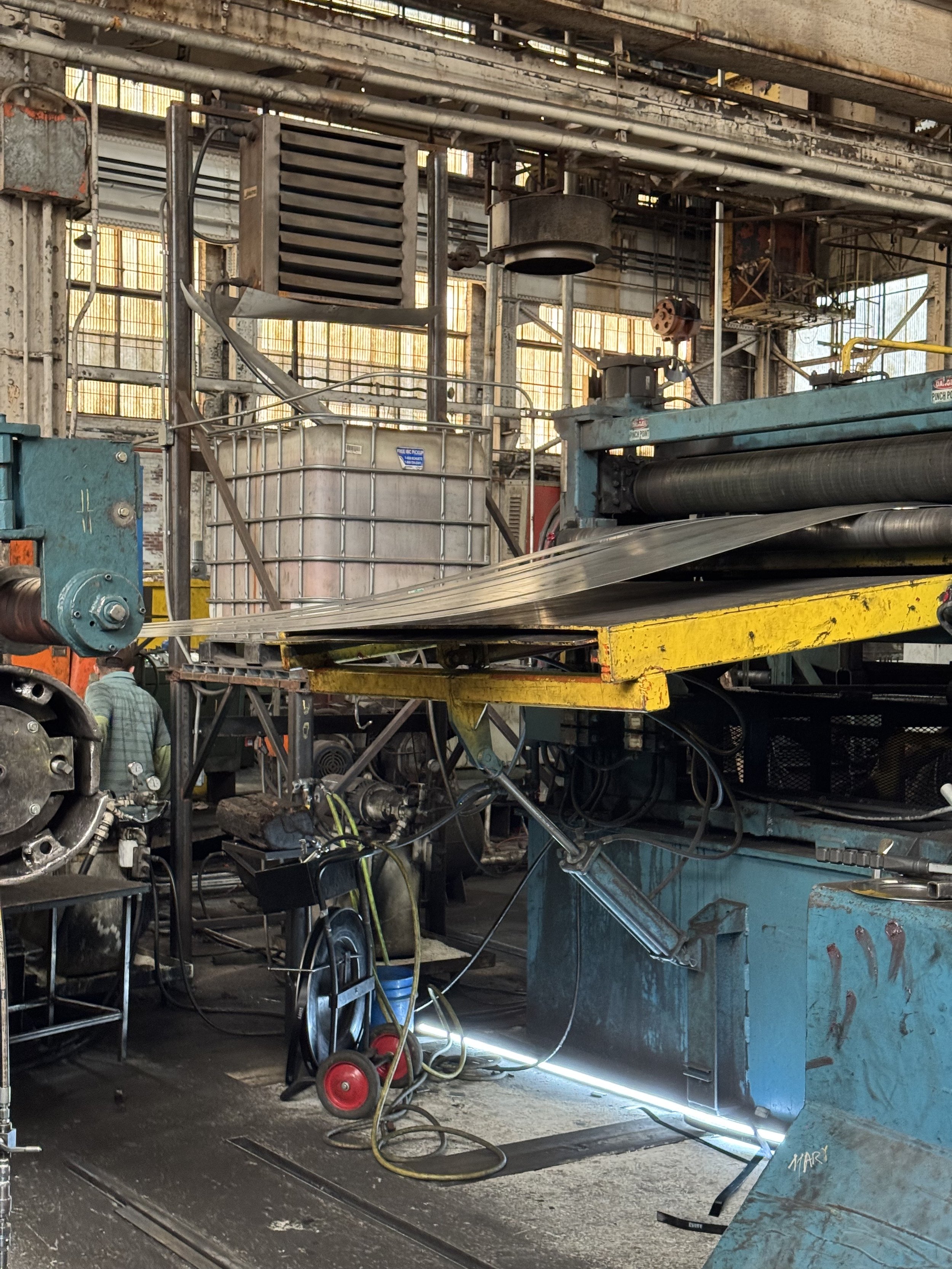
Processing: Our 72" slitting line delivers material to ASTM Standard width tolerance. Tension leveling corrects shape defects like edge wave, center buckle, and coil set. The material you receive is flat, properly sized, and ready to fabricate.
Gauge range: We specialize in the heavy gauges structural fabricators need most — 11 gauge through 1/4” — with minimums as low as 5,000 lbs in specialty gauges.
Lead times: In-stock material ships in 3–5 days. Sourced material with processing is typically 8–15 days — a fraction of prime mill lead times.
Quick Decision Checklist: Is Secondary Steel Right for This Job?
Run through these five questions for any structural fabrication project. If you answer “yes” to three or more, secondary steel is a strong candidate.
| Question | If Yes |
|---|---|
| Will the part be painted, primed, powder-coated, or galvanized? | ✓ Use secondary |
| Is the part hidden inside an assembly, behind cladding, or underground? | ✓ Use secondary |
| Is the primary requirement structural strength rather than surface finish? | ✓ Use secondary |
| Does the customer specification allow ASTM-compliant material (without requiring specific mill or “prime only” language)? | ✓ Use secondary |
| Is material cost a significant factor in project competitiveness? | ✓ Use secondary |
The Bottom Line for Structural Fabricators
Structural fabrication is the single strongest use case for secondary steel. The parts are hidden, painted, or coated. The design requirements are mechanical, not cosmetic. The material volumes are high enough that 15–25% savings translate into real money. And the steel itself — verified through testing, documented with MTRs, compliant with ASTM specifications — performs identically to prime.
The fabricators who are winning bids in competitive markets aren't necessarily the ones with the lowest overhead or the fastest welders. Many of them are the ones who've figured out that specifying prime steel for hidden structural components is paying a premium for nothing. Secondary steel is one of the simplest ways to improve margins without changing anything about your fabrication process, quality standards, or end product.
Collier Metals stocks and processes secondary steel from domestic mills in the gauges structural fabricators use most. Every coil is evaluated, tested, and documented. Precision slitting and tension leveling deliver material that's ready to fabricate, with lead times measured in days instead of weeks.