Collier Metals | Secondary Steel Education Series | 9 min read
Most surface defects do not affect steel strength. That single fact is the reason the secondary steel market exists—and the reason fabricators, manufacturers, and purchasing managers can save 10–20% on material costs without sacrificing performance. A scratch on a steel coil looks bad. A roll mark feels rough under your fingers. An oil stain makes you wonder if something went wrong at the mill. But none of those imperfections change the yield strength, tensile strength, or elongation of the steel underneath.
The distinction between cosmetic surface defects and true structural defects is one of the most important concepts in steel procurement. Understanding this difference helps you make smarter purchasing decisions, avoid overpaying for prime material when secondary steel would perform identically, and confidently specify materials for your applications.
This guide breaks down every major category of steel coil defects, separates the ones that are purely cosmetic from those that genuinely compromise structural integrity, and explains how mechanical testing verifies that secondary steel meets the same ASTM specifications as prime material.
Does Scratched or Stained Steel Have Less Strength?
No. Scratches, roll marks, staining, and most other surface imperfections are exactly that—surface-level issues. They affect appearance, not performance. Steel gets its mechanical properties—yield strength, tensile strength, and elongation—from its chemistry and the rolling process, not from the condition of its outer surface.
Think of it this way: a car with a scratched bumper still has the same engine, the same frame, and the same crash rating as the day it rolled off the lot. Steel works the same way. The mechanical properties are built into the material's cross-section, not its surface finish.
This is why steel mills classify coils with surface imperfections as "secondary" rather than scrapping them. The material is mechanically identical to prime steel—it just doesn't look as clean.
Surface Defects That Don't Affect Strength
The following defects are cosmetic only. They may affect appearance, coating adhesion, or suitability for exposed applications, but they do not reduce the steel's load-bearing capacity, yield strength, tensile strength, or ductility.
Scratches, Roll Marks, and Mechanical Surface Marks
These are the most common reasons steel coils get downgraded from prime to secondary. They include:
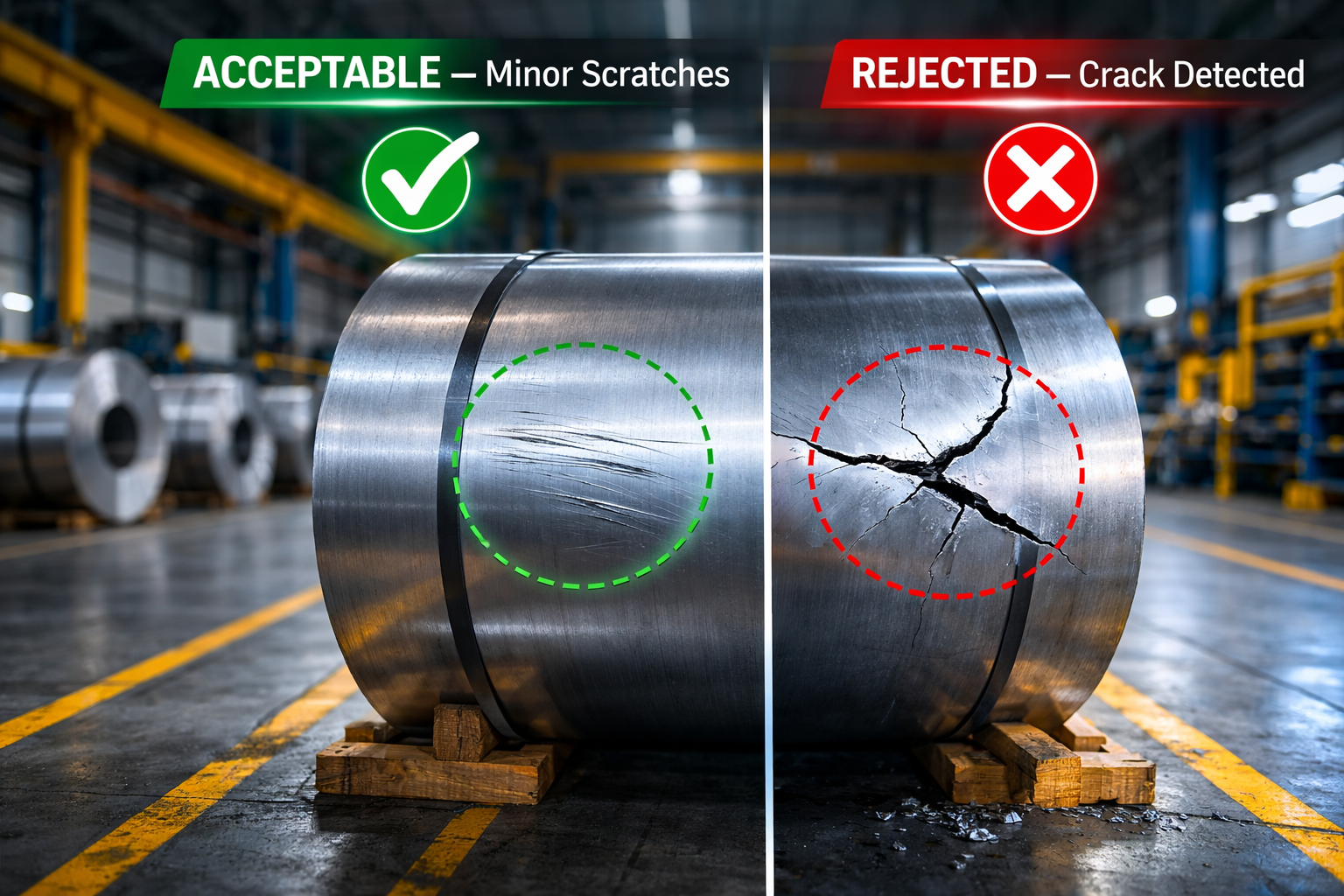
Scratches – Linear surface damage from contact during handling, transportation, or coil processing. Scratches are shallow and do not penetrate into the steel's cross-section.
Roll Marks – Repeating indentations transferred from mill rolls during the rolling process. These are impressions on the surface, not material loss.
Roll Bruise – Indented marks from handling damage, typically from coil-on-coil contact during storage or shipping.
Pinch Marks – Indentations from pinching during coil processing or handling equipment.
Chatter Marks – Periodic surface patterns caused by vibration in mill equipment. Purely cosmetic and often barely noticeable.
Friction Gouges – Longitudinal scratches caused by friction during processing. These are surface-level only.
None of these defects reduce the steel's cross-sectional area or alter its microstructure. A coil with roll marks has the same yield strength and tensile strength as an identical coil without them.
Staining and Discoloration
Staining is another frequent reason steel gets classified as secondary. These defects affect color or surface appearance but have zero impact on mechanical properties:
Oil Stains – Residue from processing oils that didn't get fully removed. Cleaned easily with solvent or burned off during welding or painting prep.
Rust Spots – Isolated surface oxidation from moisture exposure during storage. Light rust is removed through normal surface preparation.
Acid Staining – Discoloration from the pickling process. Affects color, not chemistry or strength.
Emulsion Stain / Wet Temper Stain – Residual marks from rolling fluids. Cosmetic only.
Annealing Stain – Discoloration from heat treatment. The annealing process itself is intentional—the stain is just a visual byproduct.
Color and Appearance Variations
These defects are common in galvanized and coated steel:
Color Variation – Inconsistent color across the coil surface. Does not affect zinc coating weight or corrosion protection.
Gloss Variation – Inconsistent surface sheen. Purely visual.
Dull Appearance – Lack of expected luster on the surface. No structural significance.
Grayness – Dull gray coating appearance on galvanized steel. The zinc is still there and still protecting.
Spangling Variation – Differences in the zinc crystal pattern on hot-dip galvanized. Sometimes actually desired for aesthetic effect.
> KEY TAKEAWAY If the steel will be painted, powder-coated, enclosed in a structure, or otherwise hidden from view, cosmetic surface defects are irrelevant. You're paying a premium for appearance that nobody will ever see.
Defects That Do Affect Structural Integrity
Not all defects are cosmetic. The following categories represent genuine concerns that can reduce load-bearing capacity, compromise formability, or cause failure in service. These defects affect the steel's cross-section, internal structure, or through-thickness integrity.
Cracks
Cracks are the most serious category of steel defects because they represent actual separations in the material that propagate under stress:
Transverse Cracks – Cracks running perpendicular to the rolling direction. These directly reduce the effective cross-section carrying load and can propagate rapidly under tension.
Longitudinal Cracks – Cracks running parallel to the rolling direction. Weaken the material along its length.
Edge Cracks (through-thickness) – When edge cracks extend through the full thickness of the material, they create stress concentration points that can lead to fracture during forming or in service. Note: shallow edge cracks confined to the edge zone can often be removed through slitting edge trim.
Surface Cracking – Widespread cracking on the steel surface indicates a more fundamental material problem, possibly from improper rolling temperatures or chemistry issues.
Weld Zone Cracking – Cracks in or near weld areas that compromise joint integrity.
Important distinction: Coil breaks (narrow, irregular deformation lines) look similar to cracks but are actually shape defects from improper coiling tension. They don't typically affect structural performance—though they can be cosmetically objectionable and may affect formability in precision stamping applications.
Lamination and Internal Separations
These defects occur within the steel's internal structure, making them particularly dangerous because they may not be visible on the surface:
Lamination – Internal layer separation within the steel caused by inclusions or gas pockets during casting. Reduces effective thickness and can cause delamination under load.
Edge Lamination – Separation at the edges that exposes internal layers. Can be partially addressed through edge trim, but the root cause may extend inward.
Delamination – Active separation of internal layers. Compromises through-thickness strength and makes the material unsuitable for structural applications.
Holes, Severe Pitting, and Material Loss
Any defect that removes material from the cross-section directly reduces load-carrying capacity:
Holes – Through-thickness openings in the steel. Obvious structural concern—eliminates material where load needs to transfer.
Severe Pockmarks – Deep, rough surface depressions that meaningfully reduce local thickness.
Over-Pickling – Excessive acid attack during descaling that thins the material beyond specification tolerance.
Severe Scale and Inclusion Defects
Severe Rolled-In Scale – When scale is deeply embedded during rolling, it creates discontinuities that act as stress concentrators. Light rolled-in scale is cosmetic; heavy rolled-in scale that creates pitting or voids is structural.
Inclusions – Non-metallic particles trapped in the steel during casting. Large inclusions create weak points that can initiate cracks under fatigue loading.
Slivers – Elongated surface tears or separations. Deep slivers that extend into the material's cross-section reduce effective thickness.
Quick Reference: Cosmetic vs. Structural Defects
Use this table to quickly assess whether a defect on a secondary steel coil is cosmetic only or a potential structural concern:
| Defect Type | Impact on Strength | Application Guidance |
|---|---|---|
| Scratches | None | Acceptable for all structural and hidden applications |
| Roll Marks / Bruises | None | Acceptable for all structural and hidden applications |
| Staining (oil, rust spots, acid) | None | Acceptable for all applications; clean before painting |
| Color / Gloss Variation | None | Acceptable unless exposed Class A surface required |
| Coil Breaks | Minimal | OK for structural; may affect precision forming |
| Light Rolled-In Scale | Minimal | OK for structural; remove before painting/coating |
| Through-Thickness Cracks | Significant | Reject for structural use; evaluate for non-critical parts |
| Lamination | Significant | Reject for structural and forming applications |
| Holes / Severe Pitting | Significant | Reject — material loss reduces load capacity |
| Large Inclusions / Deep Slivers | Moderate to Significant | Evaluate case-by-case; reject for fatigue-loaded parts |
How Mechanical Testing Verifies Strength Regardless of Appearance
The definitive way to confirm that surface defects haven't compromised a steel coil's performance is mechanical testing. This is standard practice for secondary steel and involves three key measurements:
Yield Strength (ksi) – The stress at which steel permanently deforms. For ASTM A36, the minimum is 36 ksi. For ASTM A1011 SS Grade 40, it's 40 ksi. Secondary steel routinely meets or exceeds these minimums because the properties come from chemistry and processing—not surface condition.
Tensile Strength (ksi) – The maximum stress the steel can withstand before fracturing. This determines the ultimate safety margin. Secondary steel with scratches or staining hits these same numbers because tensile strength is a bulk material property.
Elongation (%) – How much the steel stretches before breaking, which indicates ductility and formability. This property is critical for fabricators who need to form, bend, or stamp the material.
When secondary steel is mechanically tested and the results show it meets ASTM specification minimums, you have documented proof that the material performs identically to prime. The mill test report (MTR) from the original production plus supplemental testing provides full traceability and specification compliance.
When Surface Finish Actually Matters: Applications to Consider
While surface defects don't affect strength, there are legitimate reasons to care about surface condition in certain applications:
Exposed architectural surfaces – Facades, decorative panels, and visible structural elements where appearance is part of the design specification. These typically require Class A or Class B surface quality.
Automotive exposed panels – Hoods, doors, fenders, and other body panels that will receive paint and be visible to the end consumer. These demand near-perfect surfaces.
Appliance exteriors – Refrigerators, ovens, and washing machines where the steel surface is the final visible product. Surface imperfections show through thin paint.
Precision forming operations – Deep drawing and complex stamping where surface imperfections could create stress risers during extreme deformation.
Coating adhesion requirements – Heavy rolled-in scale or contamination can prevent paint, powder coat, or plating from adhering properly. However, standard surface preparation (grinding, blasting, chemical prep) resolves most issues.
For everything else—structural fabrication, HVAC ductwork, equipment frames, tube mill feedstock, agricultural implements, mezzanine framing, base plates, hidden components, and any part that gets painted or enclosed—surface cosmetics simply don't matter.
The Real Cost of Specifying Prime When Secondary Would Work
Understanding the surface vs. structural distinction has direct financial implications. Consider a typical scenario:
| Prime Steel | Secondary Steel | |
|---|---|---|
| Material: A36, 10 gauge | $900/ton | $720/ton |
| Project quantity: 20 tons | $18,000 | $14,400 |
| Savings using secondary | — | $3,600 (20%) |
| Yield strength | 36 ksi min. | 36 ksi min. |
| Tensile strength | 58–80 ksi | 58–80 ksi |
Same specification. Same mechanical properties. Same ASTM compliance. The only difference is cosmetic surface condition—on material that’s going to be welded into a frame and painted.
Over the course of a year, fabricators processing 200+ tons of steel can redirect tens of thousands of dollars from material costs to other business needs simply by correctly identifying which applications truly require prime surface quality and which don’t.
A Practical Framework for Evaluating Secondary Steel Defects
When you receive a secondary steel coil or evaluate a potential purchase, use this three-step process:
Identify the defect category. Is it a surface/cosmetic issue (scratches, staining, color variation) or a structural concern (cracks, lamination, holes)?
Match against your application. Will the finished part be exposed or hidden? Structural or decorative? Painted or bare? If it's hidden and structural, cosmetic defects are irrelevant.
Verify with testing. Request mechanical test results to confirm yield, tensile, and elongation meet your ASTM specification requirements. This eliminates uncertainty regardless of visual appearance.
This framework keeps the evaluation objective. Rather than rejecting steel because it doesn't look perfect, you're making decisions based on whether the material will actually perform in your specific application.
How Collier Metals Evaluates and Processes Secondary Steel
At Collier Metals, we evaluate every secondary coil against both cosmetic and structural criteria before it enters our inventory. Our process includes:
Visual inspection and defect identification using our comprehensive 150+ defect reference system to categorize every imperfection
Mechanical testing to verify yield strength, tensile strength, and elongation meet ASTM specification requirements
Processing to correct fixable defects – our precision slitting removes edge defects (edge wave, edge cracks, burrs, camber) to ±0.005" width tolerance. Our tension leveling corrects shape defects including edge wave, center buckle, and coil set.
Full documentation including original mill test reports, our certified mechanical test results, and as-processed dimensions for complete traceability
The result: secondary steel that's been verified, processed, and documented to perform identically to prime material—at a meaningful cost savings. We source exclusively from domestic mills, so all material meets U.S. ASTM specifications with full traceability.
The Bottom Line
Steel coil defects fall into two fundamentally different categories. Surface defects—scratches, roll marks, staining, color variations, and minor coating imperfections—are cosmetic issues that don't affect the mechanical properties that determine whether steel can do its job. Structural defects—cracks, lamination, holes, and severe material loss—are genuine concerns that require rejection or careful evaluation.
For the majority of fabrication, manufacturing, and construction applications, the steel's surface appearance is irrelevant to its performance. And that's the opportunity: by understanding which defects matter and which don't, you can source secondary steel that delivers the same mechanical performance at 10–20% less cost.
Ready to Source Secondary Steel? Collier Metals stocks and processes secondary steel from domestic mills in a wide range of gauges, with precision slitting, tension leveling, and mechanical testing included. We help you match the right material to your application—so you save money without compromising performance.